Of the few
photographers who could present a credible travel photography
masterclass, Julian Comrie has a lifetime of experience in taking
stunning pictures which is acknowledged at the highest level; including
the Royal Photographic Society who have awarded him a Fellowship. |

|
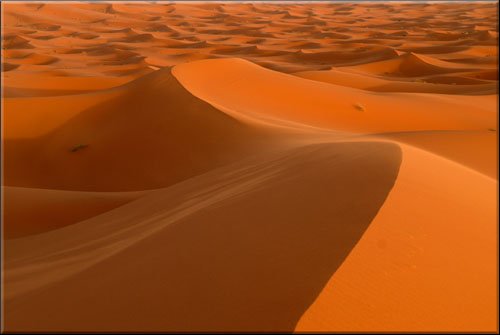 |
Picture
1 (Nikon
D200 F5.6 1/125sec
[Compensation-1/3
stop]
ISO 100) |
One of the philosophical problems with
photography is that it can be
subdivided into various categories, depending on the subject matter and
the purpose for which the photographs were taken. Often the
boundaries of such divisions are specific and clear, but in other cases
there is a distinct overlap and conjunction.travel photography
This
is so in the case of travel photography, which can be sufficiently
varied in scope to include genre such as Applied, Landscape,
Portraiture, Documentary and Photojournalism. This
tends to make a definition of travel photography rather difficult
within
that framework, so I tend to adopt a subjective definition, and suggest
that travel photography is that which offers “a sense of
place”. This can be expanded to suggest that successful
travel pictures should inspire the viewer, and create a
desire to learn more about the place, or better still, visit it.
It’s not only place, either. A set of travel
pictures can represent place, as illustrated by landscape or
architecture, but equally it could be showing a journey, the people who
live in a particular place, or an event or activity in some particular
location: or of course, a combination of any or all of those.
One also needs to qualify “place”. Travel
photography doesn’t have to be “abroad”: it can take place anywhere in
the world, and can start as soon as you step outside your front
door. Or the door of your hotel, or your ship, canoe, tent,
or cave – and now we’re getting somewhere!
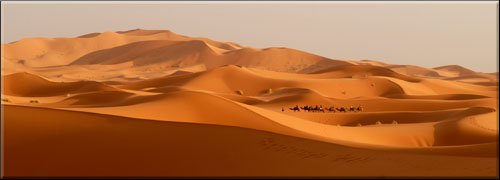 |
Picture
2 (Nikon
D200 F8.0 1/160sec
[Compensation-1/3
stop]
ISO 100) |
This wide ranging definition now underpins the skills which are needed
to be a successful travel photographer –travel photography
- On the one
hand, there is the slow, deliberate style required by the landscape
photographer, where time is taken to choose the viewpoint, to set the
camera, and above all, to wait for the right atmosphere and lighting,
and if need be to return at a more appropriate
time.travel
photography
- The documentary aspects require a formal plan
of what is to be documented, how it is to be portrayed, and if
necessary obtaining the necessary permissions to visit particular
places, which may be closed to the general public.travel photography
- Environmental
portraiture of people in their work places or homes is
yet another skill, and demands in addition to photographic ability, a
high degree of inter-personal ability; while photo-journalism calls for
quick reactions, and of course, the overriding requirement of being in
the right place at the right time.
The true
travel
photographer should have a full understanding of all these skills.
There are two
major facets to successful photography of any sort, and
they are – in no particular order –
- a complete understanding of the
physics, optics, and mechanics of the photographic process – how
cameras work and
- a highly sensitive visual ability – the
ability to recognize, or pre-visualize – a picture, which
most
importantly includes how to represent the three-dimensional world about
us successfully in only two dimensions in the photographic
image.
With travel photography there is also a very important third
requirement: complete,
devoted passion to the job in
hand. There are at least three levels to this:travel photography
- the
happy snappertravel
photography
- the keen photographer travelling with a party
of people,
who can only take photographs in the time allotted by the dictats of
the tour organizer
- the lone photographer who is paying his or her
own way to be in the place of their choice for as long as it takes,
without distraction from anyone else. (Hence the reference to
tents and caves!) Not everyone can do this, but a high level
of devotion and concentration does tend to produce the best
photographs.
Key
Issues
–
There are a number of issues which contribute to good travel
photography, and here are some of them.
Intent.travel photography
Where do you
want to go, what do you hope to see, and what do you want
to photograph? When you have answered those questions, plan
your journey: read the guide books, study the maps.
If you are in
control of your journey, you could make a diary schedule,
listing the pictures you want from specific
locations. Keep this with you, tick them off, and
also make notes of other things you take, and things that you may wish
to retake.
An
understanding of what makes a good photograph.
The word
“impact” comes to mind, which is principally concerned with
subject interest, coupled with the vital ingredients of good
composition and lighting, creating atmosphere.
 |
Picture 3(Nikon D200 F9.0 1/320sec ISO
100) |
Choice of
equipment and materials.travel
photography
Whilst
travelling, the choice of materials is now much easier with digital
than it was with film. Flash cards are insensitive
to x-rays, and can, weight for weight, hold more pictures than
films. Take plenty, and a small hard drive (eg
Giga) to back them up.
Cameras and lenses come down to personal choice. For me, the aims are
reliability and ease of use, without carrying too
much weight. My current camera is a Nikon D200 with
an 18 to 200mm VR lens, which covers most things. I
also always take a spare D200 (if you’re going to have a spare – which
is essential really – make it exactly the same as the other.
It means you don’t have to think “how does this one
work?”) I also take other lenses, but don’t
necessarily carry them all the time – a wider angle, a micro or two,
and a longer focal length for occasional use.travel photography
A tripod is essential at times, and a pain at
others. For landscapes, architecture, record type
close ups, it is supremely useful, but in a souk in Morocco – forget
it!
In case anyone doesn’t know, a tripod has
two
different uses:
– the obvious one is to hold the camera still while a
photograph is being taken – particularly important in poor light, or
when using a small aperture to get a greater depth of
field.
– the other is to allow you to lock the camera
in your chosen position while lining it up for a picture, and then look
around for alternatives: come back to the camera, and it is still where
you left it: now you can compare alternative viewpoints with a sensible
degree of accuracy.
|
Filters –
especially graduated – are at times essential for controlling
contrast, especially in bright skies. Consider also
the sparing use of a polarizer. Beware of flare
caused by extraneous light falling on the lens; use a lens hood, or
shade the lens with a hand, or hat, or anything handy.
travel photography
Remember to use the flash when appropriate. When is
that? Not too often, in my opinion, and try to keep
it off the camera, in order to give modeling light. (The Nikon SB800
can be used in wireless mode – ie controlled by the
camera, but with no connecting wires – it’s great! Other system users
should look out for theCanon Speedlite 580EX II and the
Olympus FL-50R.)
The most beneficial
use of flash is as a fill-in, especially outdoors
in bright light, in order to reduce contrast and gently illuminate dark
areas, particularly faces against the light; but don’t over-do it – set
it to minus one or two stops.
The vital thing is to be totally familiar with all your equipment, so
that you can set it and work it almost without
thinking.
Subject
selection.
This can
hardly be more
important! There are three
aspects. The first is to be prepared: if you are
travelling to some specific location, you should know what to expect
(why else are you going there?!), but do your homework first: find out
what will be there, when, where, and make plans for this.
Secondly, be
prepared for the unexpected, and ready to photograph
surprises instantly.travel
photography
The third aspect is of course the fine tuning of subject selection at
the moments before taking the picture, and this is where this topic
overlaps with the next issue, which is:
Composition,
lighting and atmosphere.
 |
Picture 4(Nikon D200 F4.0 1/350sec [Compensation-1/3
stop]
ISO 100) |
Given that
some
subjects are static, and you can take your time over setting up,
choosing your viewpoint and the consequent composition, this should be
a calm, considered affair; you may even have time to wait for the right
lighting – remember that the sun does go round once a day, and shines
in a different direction in the afternoon from the morning! This is
relevant in the case of architecture. You
may have to wait longer for the atmosphere to change: but equally, when
the atmosphere is dramatic, look for something to put in front of it.
Be aware that where you place the camera in relation to the subject,
and where you specifically point it, controls the perspective and
composition of your picture. The choice of focal
length of lens then controls the field of view. The
moment you move the camera, the picture changes. My preferred
method of working is to decide on the subject, then the absolute
position of the camera, the direction in which the camera is pointing,
and the field of view, in that order.
If you don’t
understand the last paragraph, try reading it again!
Then do three things: firstly, look with one eye only at the view you
have chosen – just like the camera. Ask yourself,
what is in direct line with what: do any parts of the subject overlap
one another to such an extent that they interfere
visually? Make sure all the parts of the picture
that you want to express clearly are indeed clear. (This should
eliminate the classic ‘he’s got a telegraph pole growing out of his
head’ syndrome).
travel
photography
Secondly, check the background. This can be one of three types:
compatible, bland, or objectionable. Make sure it is one of the first
two. Compatible implies that there may be things in the background
which positively contribute to the make up and content of the
photograph; sometimes things can be deliberately included to give an
extra meaning to the picture. Bland infers a plain non-obtrusive
background which allows the subject to be seen without interference.
The meaning of objectionable should be self evident, but all too often
such a background remains un-noticed, until it is too late. Check
before you shoot.
Finally, do a “border patrol” – look around the edges of the frame to
make sure that you have got in what you want, and there is nothing in
the picture
that you don’t want.
If there are people “in the way”, have patience. Often
when I see a good view, currently spoilt by people in front of it, I
choose what I want to take, put the camera on a tripod, with a cable
release, and then wait until either the people have moved completely,
or gone behind a bush or column; or alternatively – and this can prove
very pleasing at times – wait until they form a good shape or
composition within the frame. Watch the view, and
snap as and when required.
For the dynamic subjects – people, activities, events – be prepared to
take lots of pictures, but remember all the time the “rules” of
composition (there are none, really, but what looks good matters!) and
think as you watch and photograph: how are the people about to move:
are they coming towards you (good) or do you have back views (maybe not
so good – but it depends what impression you are trying to
create). Which were the good moves; will they do it
again; beware of intrusive backgrounds; move yourself if need be; which
direction is the light coming from, etc etc.
Try to fill the frame appropriately, which is controlled by your
distance from the subject, and the focal length of the lens in
use. In this method of working, the actual moment
at which you press the shutter is also critical.
Capturing a momentary glance or movement can be difficult, and the
right moment is crucial.
In all cases, remember that possibly the most important element of any
camera is the viewfinder, and that it is exactly that: a view finder,
not a gun sight. If you fail to make a picture in your viewfinder, you
will fail to have a picture in your library.
 |
 |
Picture 5(Nikon D200 F4.5
1/80sec
[Compensation-1/3
stop]
ISO
200) |
Picture 6(Nikon D200 F9.0
1/320sec
[Compensation-1/3
stop]
ISO
100) |
Style and
Presentation.travel
photography
This is
entirely a personal issue;
style is developed over the years; presentation is what you do with
your photographs after your journey. Do show them
off appropriately, rather than leaving them languishing in drawers, or
on a hard disc. However, a word of warning is
required: it is generally accepted in this genre, that truthfulness is
paramount, and that if one is presenting pictures under the title of
travel photography, they should represent reality. In other words,
manipulation by digital or other means which
significantly alters the truth of the situation or event is out of the
question.
Disciplined
Administration.travel
photography
This applies
to all aspects of
photography, and is particularly relevant to travel photography if you
wish to use your pictures for publication, or academic or scientific
use. It is important to know what, when, and where
they are of; diaries, maps, GPS readings, and notebooks are essential
field tools. Keep good records, or the value of the
pictures decreases.
 |
Picture 7(Nikon D200 F5.6 1/320sec [Compensation-1/3
stop]
ISO 100) |
Some other
points, not in any particular order.
- Keep in mind the normal requirements of travel:
look after yourself,
and your equipment, and have suitable, comfortable clothes, and
medication to hand.
- Weight: don’t carry too much in the field.
- Consider how you are going to carry it –
rucksack, shoulder bag, or
pocket. Don’t make yourself unable to operate
because you are over laden; or vulnerable to derision, or theft.
- Keep your camera equipment clean; the great
enemies are dust, sand,
water, vibration and heat.
- Security is an issue: keep your kit in sight at
all
times. Be well insured. Have a detailed
list of your equipment, with serial numbers and values, kept safely
elsewhere – eg with your passport.
- Be aware of local culture, especially if it
different from your
own.
- Do not offend host people in their country. Ask
before you take photos of people, and accept that no means no.
- On an outward journey, and during a field trip,
your camera equipment
is vital and precious; on the return, keep your used flash cards very
safely somewhere – they may be more valuable than your equipment.
- Make sure you cover your subject in depth:
people, buildings,
landscape, artifacts, the lot. Also don’t overlook
the possibility of taking photographs from a moving vehicle: set a
large aperture, and a high ISO value, which together will generate the
fastest possible shutter
speed, and use VR if you have it; otherwise much of your journey may go
unrecorded. You may only get a 10% hit rate, but
that’s a lot better than none.
 |
Picture 8(Nikon D200 F7.1 1/180sec [Compensation-1/3
stop]
ISO 100) |
Remember that photography is a technique at which it is easy to be
competent, but greatness and personal vision are difficult to achieve;
use your eyes and your brain; plan, think, then act.
The
camera will take the photograph: you make the picture.
Make
sure it is one of which you can be proud.
The pictures
used to illustrate this article were all taken in one country, and have
been specially chosen to show some particular characteristics – in this
case, places, architecture and people. It would be very easy to chose
more pictures, and show many other features of the same country.
These
pictures were all taken in Morocco in the spring of 2008.
Picture 1
is in the Sahara, taken in the evening light, when the
shadows are long, revealing the shape of the dunes. |
 |
Picture 2 shows
a camel train making its way through the sand dunes at a similar time. |
 |
By way of
contrast, a midday picture (Picture
3) shows a
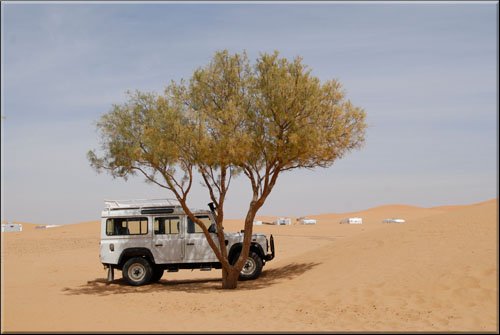
Land Rover
parked in the shade of a desert tree, while the white motor caravans in
the background sweat it out! |
 |
Picture 4
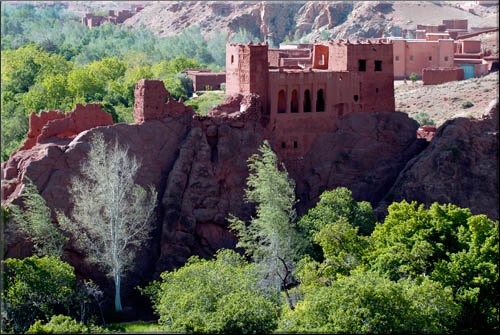
is a typical kasbah, perched atop a sandstone cliff in a
wooded gorge, with similar buildings in the background adding to the
composition. Here the light is slightly contre jour, which
shows the tree in the bottom left-hand corner to good advantage against
the dark face of the cliff wall. |
 |
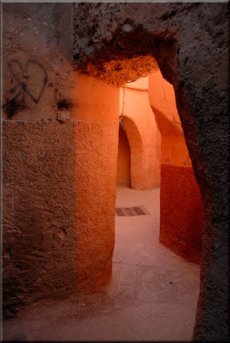
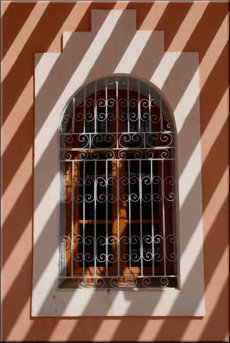
Pictures
5
and 6 show details of some of the architectural features
found in Morocco: an alleyway lit only by reflected sunlight from
above, and a window, with shadows of a slatted roof above making a
contrasting pattern on the wall. |
  |
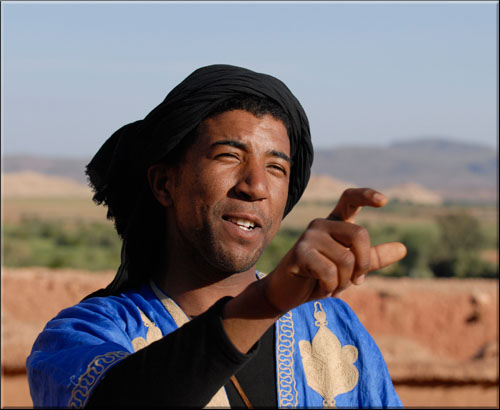
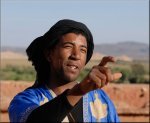
Picture
7 shows a
teacher, making a particular point with
his hands.travel
photography |
 |
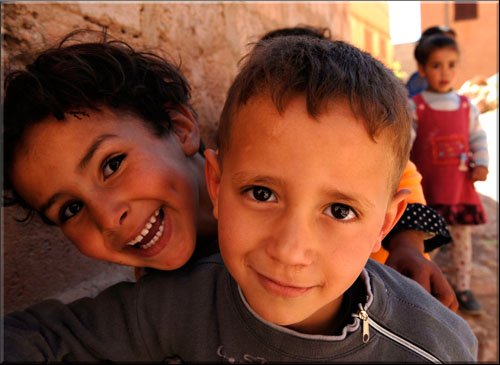
Then some
of his child pupils (Picture
8), in the shade of a wall,
obviously attracted to the idea of having their photograph taken – and
why not! Their relaxed joy is self evident. |
 |
Further
recommended reading about
Travel
Photography
- Travels with Watercolour
-Lucy Willis.Lucy Willis’s understanding and
explanations
of composition and light are first class, and this is an excellent book
for photographers, as well as artists. It also has delightful pictures
from many parts of the world.
Planning your next trip
and need some practical travel
tips? Then, make sure you visit Top Travel Tips for comprehensive and
unbiased travel advice.
Looking for ideas on
where to travel next? Take a look at our “Places to Photograph” section.


 News
News